Clinical Validation Approach
How HDIM ensures quality measure accuracy through automated validation, FHIR R4 conformance testing, and continuous evidence generation.
Why Validation Matters
Healthcare quality measurement errors have real consequences: incorrect HEDIS rates affect Star Ratings, which determine Medicare Advantage reimbursement. A 0.5-star drop can cost a health plan $50M+ in lost revenue annually (CMS Star Ratings methodology, 42 CFR 422.166).
HDIM treats validation as a continuous process, not a phase. Every code change triggers automated checks against clinical logic, FHIR conformance, and measure accuracy before reaching production.
Three Layers of Validation
1. FHIR R4 Conformance
Every clinical resource processed by HDIM is validated against FHIR R4 profiles before storage. This catches data quality issues at ingestion — malformed observations, missing code systems, or invalid reference chains — rather than at measure evaluation time.
- US Core profile validation on Patient, Condition, Observation, Procedure, MedicationRequest
- Value set binding checks against NLM-published VSAC terminologies
- Reference integrity validation across resource bundles
2. Measure Logic Verification
CQL measure logic is tested against known patient scenarios with expected outcomes. Each HEDIS measure includes test patients that exercise initial population, denominator, numerator, and exclusion paths.
- 613+ automated tests across quality measure, care gap, and patient services
- Contract tests between frontend and backend validate API stability
- Entity-migration tests prevent schema drift between JPA entities and Liquibase migrations
3. Pipeline Integration Testing
End-to-end validation confirms that a patient event entering the Kafka pipeline produces the correct care gap actions after flowing through FHIR ingestion, measure fan-out, and CQL evaluation.
- One-patient-to-N-measures fan-out validated with 5 and 10 concurrent measures
- Multi-tenant isolation confirmed — tenant A data never surfaces in tenant B evaluations
- Dead letter queue handling tested for malformed events and transient failures
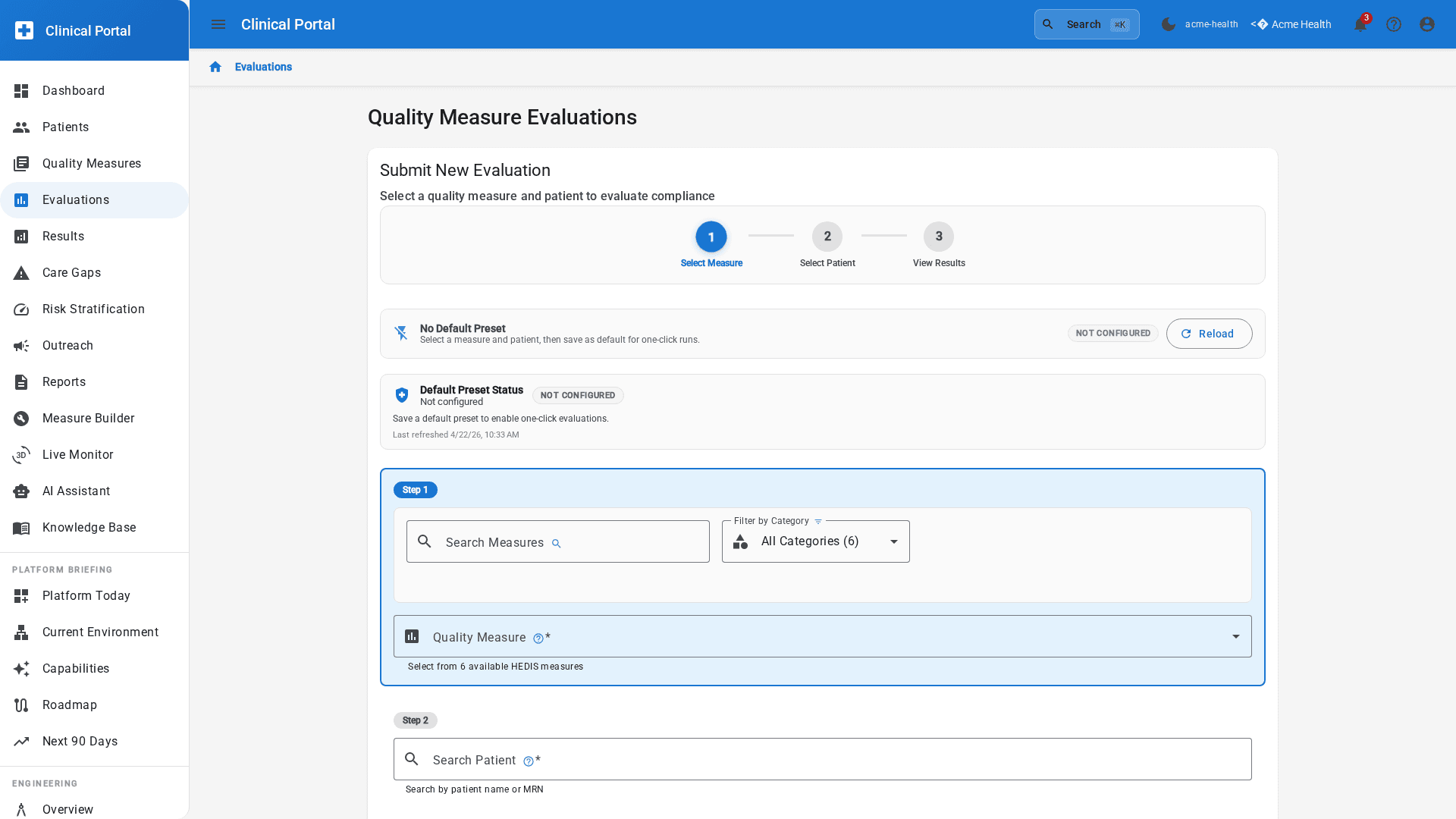
What Validation Looks Like
Continuous Evidence Generation
Regulatory audits require proof that validation actually ran, not just that it could run. HDIM generates timestamped evidence artifacts on every release candidate.
| Evidence Type | Purpose | Frequency |
|---|---|---|
| Test execution reports | Prove all 613+ tests passed before deployment | Every PR and release |
| FHIR conformance reports | Confirm R4 profile compliance | Every ingestion pipeline change |
| Migration rollback coverage | 199/199 changesets have verified rollback SQL | Every schema change |
| Security scan results | Trivy container scanning, dependency audit | Every build |
| Compliance control matrix | Map controls to evidence for HIPAA / SOC 2 readiness | Per release candidate |
What This Means for Your Organization
- Faster audits: Pre-generated evidence packages reduce audit preparation from weeks to hours
- Lower risk: Automated validation catches clinical logic errors before they affect Star Ratings
- Regulatory confidence: Commit-backed evidence ties every claim to a verifiable code change
- Continuous compliance: Validation runs on every change, not just before audits
See the Pipeline in Action
Explore how patient events flow through the FHIR pipeline from ingestion to care gap detection.